Dubai's industrial zones: production attached to a re-export machine
Manufacturing in Dubai grew out of trade rather than the other way round. Goods passed through the port and the airport first, and assembly, blending, packing and finishing were added because completing a product near the point of distribution beat shipping finished stock from origin. The industrial zones therefore favour late-stage value addition — light assembly, food processing, packaging, building products — alongside a heavy aluminium operation that predates the trading boom entirely.
- Hub type
- free zone
- Country
- United Arab Emirates
- Location
- Dubai's industrial land lies mainly in the southern half of the emirate, between the Jebel Ali port complex, the inland industrial city districts and the newer airport area.
- Logistics connections
- deep-water container port at Jebel Ali, two international airports with dedicated freighter capacity, bonded road corridor connecting seaport and airport, highway network reaching the wider Gulf and Saudi market
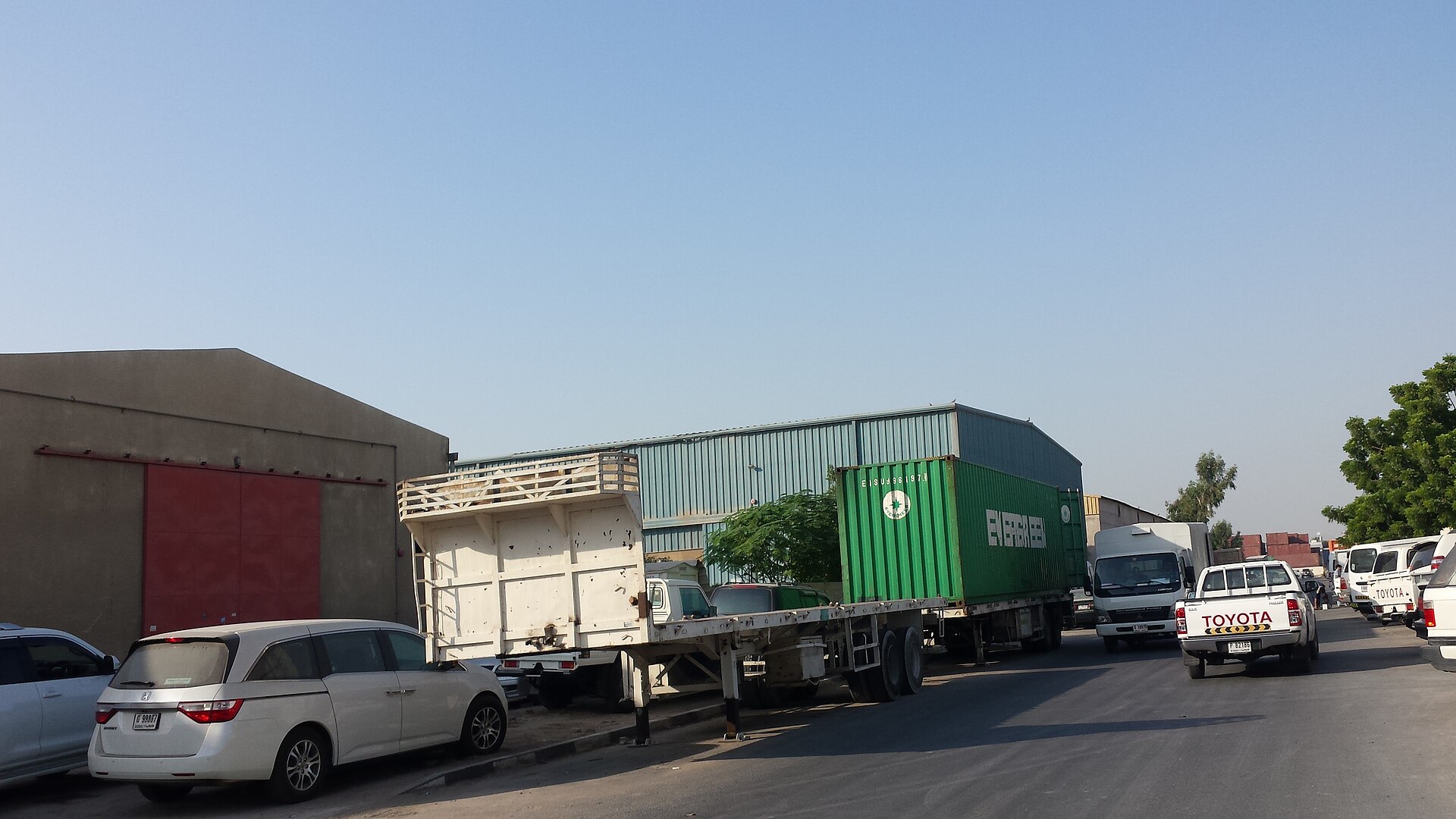
Manufacturing as the last step of a trading chain
The commercial logic is postponement. A product held as components, bulk material or unlabelled stock can be finished to the specification of whichever market orders it, which suits a region of many small national markets with different languages, standards and packaging rules. Filling, labelling, kitting, final assembly and light conversion therefore dominate, and warehousing sits physically alongside production rather than downstream of it. That model rewards firms serving several countries from one site and punishes those needing deep local input supply, because almost every raw material and component arrives imported.
Free zone or mainland: the decision that shapes everything else
A manufacturer must choose a licensing regime before choosing a building. Free zone establishments sit outside the customs territory for goods purposes, which suits import, process and re-export flows, while selling into the domestic market from a free zone involves formal import and the duty treatment that comes with it. Mainland licensing puts the company inside the customs territory with different ownership, agency and local-market rules. The choice affects customs procedure, permitted activity, hiring, and how you contract with local customers, and reversing it later means re-establishing the company rather than amending a permission.
What the local supplier base actually supports
Steel fabrication, plastics conversion, packaging converting, cabling, food and beverage processing and building products are all well represented, with a substantial contracting sector serving construction. Precision machining, specialised tooling and electronic component manufacture are thinner, so firms needing them tend to import tools and critical parts and keep local capability for maintenance and simpler production. The practical consequence is a longer inbound pipeline than the port's efficiency suggests: your port is excellent, but your supply base often begins somewhere else entirely, and lead times are set by that origin rather than by local capacity.
A workforce recruited from abroad
Industrial labour is overwhelmingly expatriate and employed on sponsored, fixed-term contracts, recruited through established channels from South Asia and elsewhere. That produces a workforce that can be scaled relatively quickly and a retention problem of a particular kind: people leave the country rather than move to a competitor, taking process knowledge with them. Employers respond with standardised work instructions, heavy reliance on documented procedure and supervisory structures that assume turnover. National policy also encourages employment and training of citizens in industry, which is a planning consideration for larger operations.
Heat, water and other physical constraints
Climate is an engineering input here, not a comfort question. Cooling loads dominate the energy profile of a production building, temperature-sensitive materials need conditioned storage from the quay onward, and outdoor work is subject to regulated summer restrictions during the hottest part of the day, which affects construction schedules and any process performed in the yard. Water is desalinated, so process water carries an energy cost. Land is generally leased within a designated zone rather than owned, with permitted-use and build-out conditions attached, so verify what your licence allows before committing to a process.
Industrial sectors present
- aluminium manufacturing
- food manufacturing
- packaging manufacturing
- plastics
- building materials manufacturing
- electrical equipment manufacturing
- metal fabrication
Frequently asked questions
- Does a free zone licence prevent selling inside the country?
- It does not prevent it, but it changes the mechanics. Goods leaving a free zone for the domestic market are treated as imports and go through customs formalities with the applicable duty treatment, often via a distributor or an agent holding the right mainland licence. Many manufacturers run both structures deliberately: a free zone site for regional export flows and a mainland arrangement for local sales. Decide which market dominates before selecting the regime, because retrofitting is expensive.
- What kinds of production genuinely fit these zones?
- Work where value is added close to the customer and where imported inputs are unavoidable anyway. Food and beverage processing for regional distribution, packaging conversion, cable and electrical assembly, building products for local construction, and final assembly or configuration of equipment all fit well. Processes needing a deep domestic component base, low energy cost or large volumes of local raw material generally do not, and firms that ignore this discover their landed input cost erases the logistics advantage.
- How reliable is the logistics advantage in practice?
- Very, for the port and airport themselves, which are built for transhipment and handle it well. The variability sits either side: ocean schedules into the Gulf, and road movement onward across borders into neighbouring markets where crossing procedures and documentation quality determine transit time. Manufacturers serving the region by truck should treat the border leg, not the sea leg, as the uncertain part of their delivery promise and plan buffers where the crossings are busiest.
Data limitations
- Manufacturing figures are operator-supplied inputs, not market data. GeoBusinessIQ holds no factory costs, production volumes, yields, cycle times, tooling prices or capacity data and does not estimate them — every result reflects only the figures you enter.
- No manufacturer, supplier, vendor or factory is recommended, rated or ranked anywhere in this cluster, and no directory of them is published. Selection material describes how to run your own assessment; the assessment itself remains yours.
Explore the graph
Industries present
- Aluminium: power contracts upstream, alloy discipline downstream
- Building materials plants: heavy, local and tied to the construction cycle
- Corrugated boxes: a delivery-radius business built around one enormous machine
- Electrical equipment makers: wound products, type tests and efficiency rules that rewrite catalogues
- Food manufacturing: perishable inputs, retailer promotions and the allergen changeover
- Frozen food manufacturing: where freezing capacity and energy set the ceiling
Supply chain context
Sources
- Jebel Ali Free Zone Authority — JAFZA (accessed )Covers: Operator information for one of the region's principal industrial and logistics free zones.Does not cover: Pricing, tenancy decisions, or comparative claims against other zones.Why it matters: Cited on hub and facilities pages for how an industrial free zone is organised operationally.Review cadence: annual
- UAE Ministry of Industry and Advanced Technology — MoIAT (accessed )Covers: United Arab Emirates industrial strategy, industrial licensing and advanced technology programmes.Does not cover: Licensing decisions, incentive eligibility, or company-level data.Why it matters: The ministry that owns UAE industrial policy and industrial licensing; cited for the UAE manufacturing environment.Review cadence: annual
- United Nations Industrial Development Organization — UNIDO (accessed )Covers: Industrial development analysis, industrial statistics methodology, and manufacturing capability programmes across member states.Does not cover: Company-level data, factory costs, supplier information, or real-time production statistics.Why it matters: The United Nations agency for industrial development; used for structural framing of how manufacturing sectors develop, never for point figures.Review cadence: annual
Educational and operational information only. This page describes an industrial location qualitatively; it publishes no output, employment, plant-count or ranking figures, names no individual manufacturer as a recommendation, and is not investment, siting, legal, or tax advice.
Last updated: